


Circular Economy

Approach
In line with global trends, for us to be able to create a more sustainable society and achieve sustainable corporate growth, we need to shift to a circular economy-type business model whereby we can achieve growth without having a serious impact on the environment. We regard the use of fossil resources-derived materials and waste discharge to the natural environment as environmental impacts that must be reduced to zero. We are committed to eliminating fossil resources-derived materials and achieving zero waste*1 as our vision. We will also continue to increase resource efficiency throughout the supply chain and build a harmonious and sustainable relationship with all resources, including bioresources.
- *1Approach to reduce waste discharge (simple incineration and landfill disposal) to the natural environment to zero and utilize all resources effectively
Circular Economy
Targets and results
| Targets |
(2028 Targets)
|
|---|---|
| 2024 Results | Simple incineration and landfill: 65% reduction |
The Otsuka approach to plastic
Otsuka group plastic policy
The Otsuka group recognizes plastic resource circulation and marine plastic waste as urgent global issues and believes they must be addressed promptly. To address this, Otsuka formulated our Plastic Policy in 2020.
Efforts to reduce and recycle plastic waste*2
The Otsuka group's aim to realize a zero-waste*3 society includes plastics. To this end, we have established a goal of decreasing simple incineration and landfill waste by 50% (equivalent to 9,000 tons)*4 by FY2030 compared to FY2019.
Otsuka Pharmaceutical will globally promote plastic waste recycling, such as PET bottles, by utilizing material recycling and heat recovery techniques.*5 This approach aims to reduce the amount of waste sent for simple incineration and landfill.
- *2Refers to waste generated by industrial activities.
- *3Aim is for no waste to be sent for simple incineration or landfill disposal.
- *4For more detailed information on waste plastics, please refer to the Environmental Performance section.
- *5This general term encompasses various methods, including power generation, heat utilization, methane fermentation, fuel utilization, and fuel conversion (such as solid fuel RPF).
Recycling of PTP packaging waste
Otsuka Pharmaceutical has collaborated with Taiho Pharmaceutical since May 2024 on a material-recycling initiative for blister/bubble pack waste generated during the packaging of pharmaceutical products.
By utilizing technology that separates blister/bubble pack sheets used for packaging tablets and capsules into plastic and aluminum foil components, approximately 55 tons of waste per year that was previously incinerated can be reused.
Reduction of plastic amenities
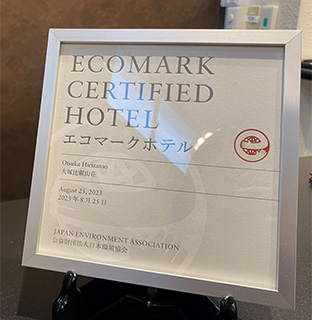
At Otsuka Hieizan Sanso (guest house), efforts are made to reduce use of plastic amenities such as toothbrushes and hairbrushes by asking guests to bring their own. This initiative has since been expanded to other company lodgings.
These broader environmental initiatives, including efforts to reduce food waste, have been recognized, and the facility became the first company lodging in Japan to receive Eco Mark Hotel certification.
Participation in the ASKUL resource circulation platform
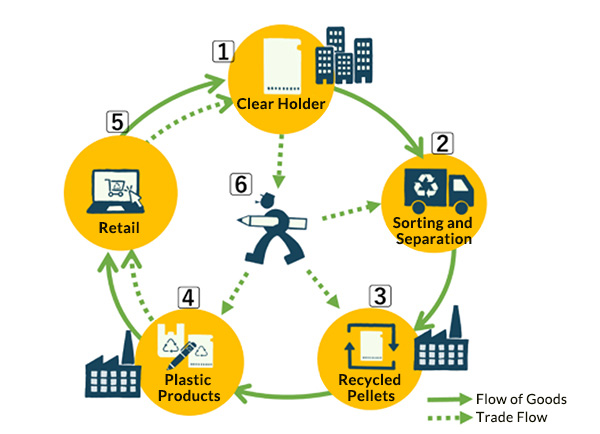
Otsuka Pharmaceutical participates in the ASKUL Resource Circulation Platform (clear files). The files used through this initiative are recycled and turned into new products for sale.
Otsuka Pharmaceutical has participated in this initiative since 2021 and recycles approximately 2 to 3 tons of clear files each year (recycling rate: over 99%).
Efforts to reduce packaging materials
Promote bottle-to-bottle*6 horizontal recycling of PET bottles
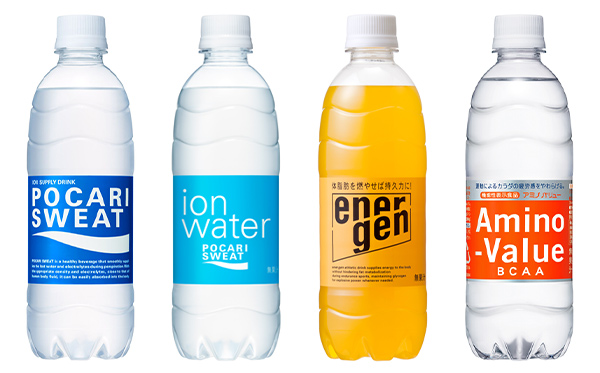
Otsuka Pharmaceutical promotes “bottle-to-bottle”*6 horizontal recycling, in which used bottles are recycled back into PET bottles. Starting in January 2026, the company began nationwide rollout of PET bottles made with 100%-recycled PET resin.*7
As a result, more than 90% of our PET bottled beverage products (by unit volume) will use PET bottles made from 100% recycled PET resin.*8 These initiatives are also expected to reduce greenhouse gas (GHG) emissions by approximately 5,300 tons.*9
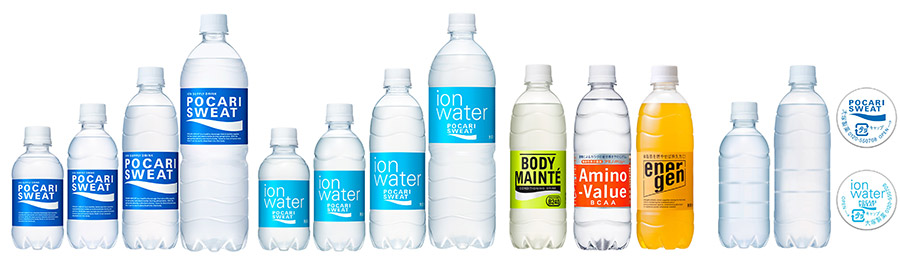
The above PET bottled beverage products have met the requirements*10 for designs compliant with the “Guidelines for Plastic Product Design” (including reduction of plastic usage, reuse of components, and use of recycled plastics) established under the Act on Promotion of Resource Circulation for Plastics. Accordingly, they have been certified under this program as plastic products that contribute to reducing the use of fossil fuel–derived resources and minimizing environmental impact throughout the entire product lifecycle.
- *6An ideal circular recycling system in which PET bottles are recycled and reused again as PET bottles
- *7PET resin recycled through material recycling (a method in which used PET bottles are sorted, crushed, washed, and processed for reuse)
- *8Based on estimates from the 2026 production plan
- *9As of January 2026
- *10“Guidelines for Plastic Product Design and Certification System,” Ministry of the Environment, Japan (circulation of plastic resources)
Collaboration with local communities and organizations
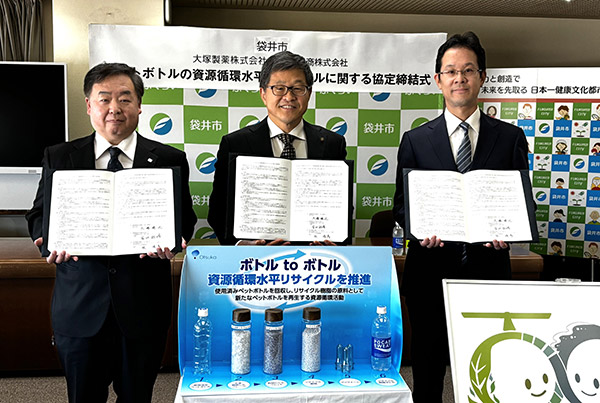
To promote bottle-to-bottle horizontal recycling, in which used PET bottles are recycled into raw materials for new PET bottles, the Otsuka group has entered into resource circulation agreements with more than 30 municipalities*11, including Tokushima Prefecture, the group's birthplace.
The group also collaborates with local communities and organizations by conducting awareness-raising activities and collecting and recycling used PET bottles at large-scale events such as the Tokyo Marathon, the World Athletics Championships Tokyo 2025, and the Fuji Rock Festival.
- *11As of February 2026
In February 2025, Otsuka Pharmaceutical signed an agreement with Fukuroi City in Shizuoka Prefecture, where the Fukuroi Factory is located. In March, an agreement wa also signed with the Eastern Saga Environmental Facility Association, established by Tosu City, Kanzaki City, Yoshinogari Town, Kamimine Town, and Miyaki Town, promoting local production and recycling of PET bottles at the Saga Factory.
In addition, at the World Athletics Championships Tokyo 2025, the company promoted bottle-to-bottle horizontal recycling by collecting PET bottles used at the venue and recycling them into new PET bottles. It also encouraged the use of personal and squeeze bottles by providing original bottles for athletes and 1L POCARI SWEAT squeeze bottles for volunteers.
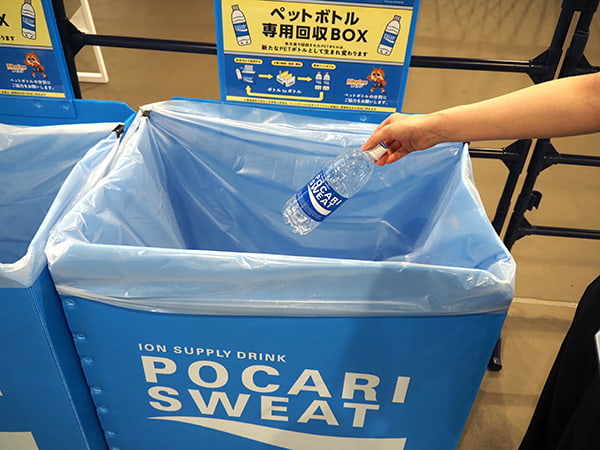
Otsuka Pharmaceutical and industry associations collaborate on educational video to promote PET bottle recycling
Otsuka Pharmaceutical is a member of the Japan Soft Drink Federation, which has created a video to raise public awareness of PET bottle recycling. We are committed to working together with the industry to further promote understanding of environmental issues.
Development of lightweight and reusable packaging
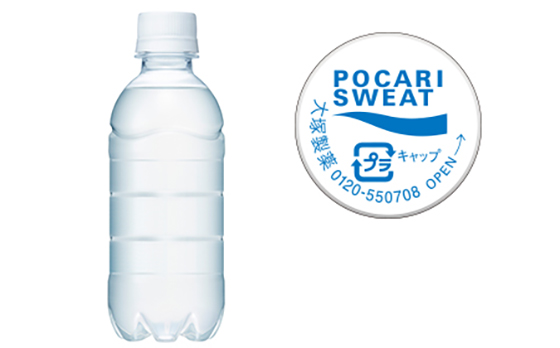
Otsuka Pharmaceutical has advanced the development of lightweight PET bottles and manufacturing methods as a pioneer in the industry to reduce environmental impacts, including for products in the Nutraceutical Business, such as POCARI SWEAT. The company continues to build on these efforts through technologies such as label-free bottles, lighter caps, and reduced use of packaging materials.
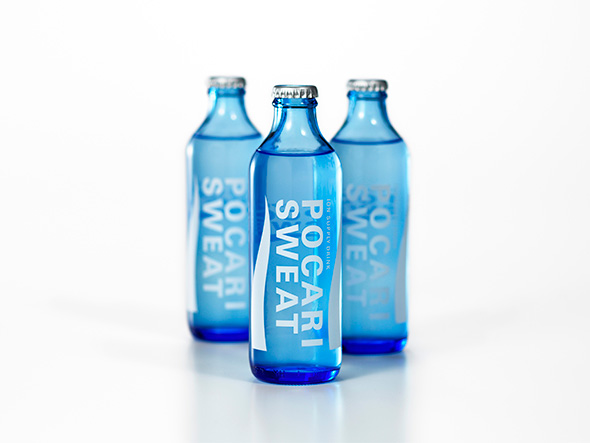
In addition, the company has developed containers that meet the strength and quality standards required for reuse models and, since July 2022, has introduced the POCARI SWEAT Returnable Bottle 250 ml.
Otsuka Pharmaceutical is also promoting environmentally conscious packaging for pharmaceutical products. This includes thinner packaging materials, more compact individual boxes, and recycled paper for paper containers. The company has also introduced plastic containers made from biomass-based plastics derived from plant-based materials.
Find out more about our environmental data