


Otsuka Pharmaceutical Co., Ltd
Nutraceuticals
July 30, 2026
The Results Suggest the Potential Usefulness of S-Equol in Women with Severe Symptoms of PMS and PMDD
New Findings Contribute to Advancing Support for Women's Health
Otsuka Pharmaceutical Co., Ltd. (Otsuka), through its Nutraceuticals Research Institute (Saga research site), conducted a randomized, double-blind, placebo-controlled study to evaluate the efficacy of foods containing soy germ lactic acid bacteria-fermented equol (S-Equol) in women with premenstrual syndrome (PMS)1 or premenstrual dysphoric disorder (PMDD)2
The results suggest the potential usefulness of S-Equol-containing food in women with severe PMS/PMDD symptoms that did not require immediate medical treatment. These findings provide new scientific evidence that may contribute to further support for addressing issues related to women's health.
The study was published in The Tohoku Journal of Experimental Medicine on July 30 (Japan time).
■Research Background
PMS, characterized by distressing psychological and physical symptoms occurring before menstruation, is estimated to affect approximately 80-90% of women of reproductive age to some degree and can have a substantial impact on daily life and work performance. PMDD, a more severe form of PMS, is known to significantly impair quality of life (QOL).
Currently, various treatment approaches, including pharmacotherapy, are used depending on the symptoms. Meanwhile, as interest in self-care practices and nutritional approaches that can be implemented in daily life continues to grow, research has increasingly focused on the effects of food-derived components on women's health.
S-Equol is a naturally occurring compound produced by intestinal bacteria from the soy isoflavone daidzein. Because it exhibits estrogen-like activity, it has been utilized to address women's health issues, including menopausal symptoms. Previous collaborative research conducted with the Kindai University Research Institute of Traditional Asian Medicine demonstrated that equol non-producers are at a higher risk of developing PMS and PMDD. However, no study had rigorously evaluated the efficacy of equol supplementation alone for PMS and PMDD using a randomized, double-blind, placebo-controlled design. Therefore, in the present study, a randomized, double-blind, placebo-controlled trial was conducted in women with PMS or PMDD, who were assigned to receive either an S-Equol-containing food or a placebo.
■Study Overview
Participants: A total of 119 equol non-producing women aged 20-45 years with PMS or PMDD symptoms that were not severe enough to require medical treatment were enrolled in the study.
Study Design: Randomized, double-blind, placebo-controlled trial.
Participants were assigned to receive either an S-Equol-containing food (providing 10 mg of S-Equol per day) or a placebo and consumed the assigned product for three months.
Symptoms were evaluated using the Daily Record of Severity of Problems (DRSP)3, an internationally recognized instrument for assessing the severity of PMS and PMDD symptoms.
■Summary of Results
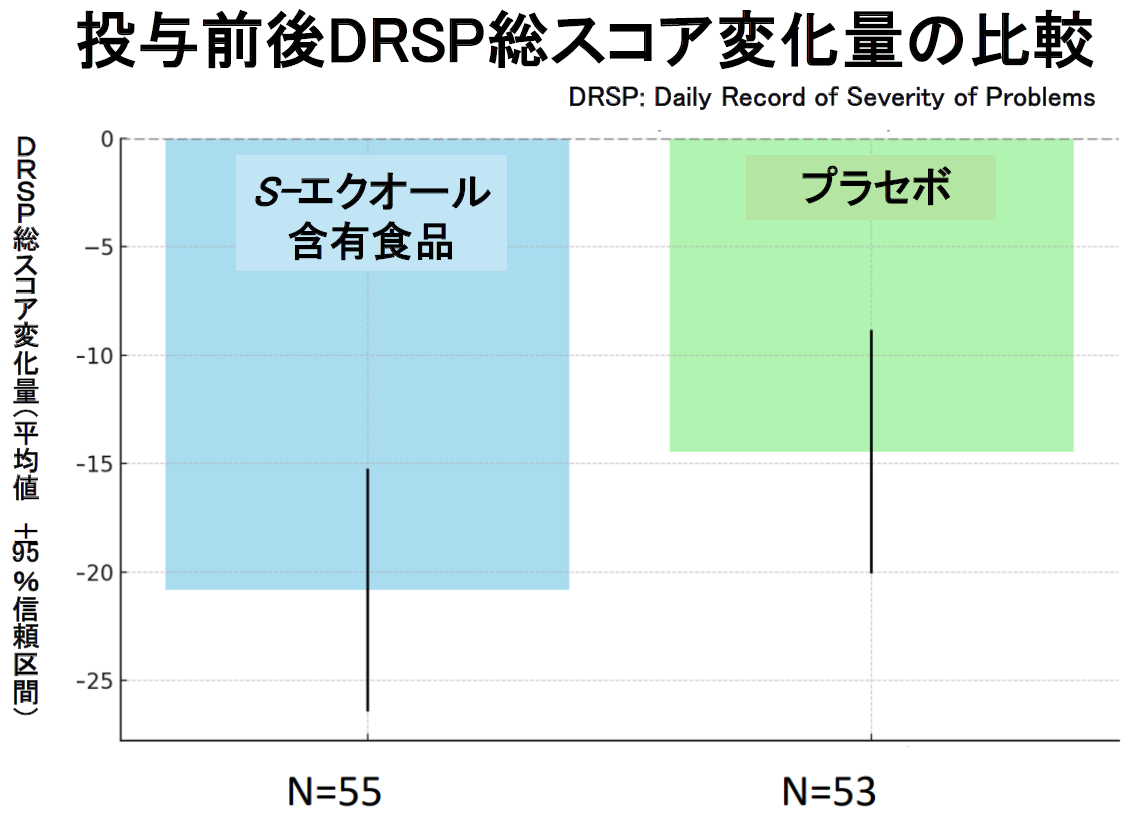
For the primary endpoint, the change in total DRSP score from baseline, the S-Equol group showed a greater degree of symptom improvement than the placebo group; however, the difference did not reach statistical significance. Nevertheless, subgroup analyses of participants with more severe symptoms yielded findings that suggest the potential usefulness of S-Equol in severe PMS and PMDD cases.
These results provide valuable information for women who experience reduced QOL and decreased work productivity due to premenstrual symptoms. The findings also represent important new evidence that may contribute to further support and solutions for women's health issues.
This study was conducted as a collaborative research project with Kindai University.
■About S-Equol
S-Equol is a naturally occurring compound produced when daidzein, an isoflavone found in soybeans, is metabolized by intestinal bacteria. Because S-Equol exhibits estrogen-like activity, it has attracted attention as a component that supports women's health and beauty.
However, not everyone has the ability to produce equol in the intestine. It has been reported that only about half of the Japanese population are capable of producing equol4.
■Otsuka Pharmaceutical's Initiatives in Women's Health
Otsuka recognizes women's health as one of the key social issues it seeks to address, acknowledging that women face unique health challenges at different stages of life. To support women's health and well-being, the company conducts research and development activities as well as educational and awareness programs.
In 1996, Otsuka initiated research on women's health issues, including menopausal symptoms and premenstrual syndrome (PMS). In 2002, the company successfully isolated Lactococcus 20-92, a lactic acid bacterium capable of producing equol. Using S-Equol produced through the fermentation of soy germ with this bacterium, Otsuka has continued to conduct research in Japan and internationally to evaluate its efficacy and safety, leading to the development and commercialization of products that contribute to women's health.
In addition, Otsuka collaborates with healthcare professionals to provide information through seminars, websites, and other educational activities aimed at supporting health maintenance and improving QOL across the various stages of a woman's life.
The findings of this study will be used to raise awareness of PMS and PMDD, as well as to promote the importance of gynecological examinations and regular health checkups.
■Research and Development in Otsuka Pharmaceutical's Nutraceutical Business
In its nutraceutical business, Otsuka Pharmaceutical leverages the expertise cultivated through its pharmaceutical business to advance the maintenance and improvement of people's health and overall societal well-being. The company is engaged in the research and development of unique, science-based products that contribute to addressing both health-related and societal challenges.
Currently, research and development related to beverages and foods is conducted at the Nutraceutical Research Institute (Saga Research Site and Otsu Research Site) and the Advanced Science Research Institute.
Based on the corporate philosophy of 'Otsuka-people creating new products for better health worldwide,' Otsuka Pharmaceutical continues to contribute to the health and well-being of people around the world.
- 1Premenstrual Syndrome (PMS): A condition characterized by psychological and physical symptoms that occur approximately 3-10 days before the onset of menstruation and improve or disappear after menstruation begins.
- 2Premenstrual Dysphoric Disorder (PMDD): A severe form of PMS characterized by pronounced psychological symptoms that significantly interfere with daily functioning and quality of life.
- 3Daily Record of Severity of Problems (DRSP): An internationally recognized assessment tool used to evaluate the severity of PMS and PMDD symptoms through daily symptom recording.
Because symptoms and their severity are documented each day throughout the menstrual cycle, the DRSP provides greater accuracy than retrospective assessments based on memory and is widely used as a standard tool in the diagnosis of PMS/PMDD and in clinical trials of therapeutic interventions. In this study, the Japanese version of the DRSP (DRSP-J), whose reliability and validity have been established, was used. - 4Journal of the Japan Society for Menopause and Women's Health, 20: 313-332, 2012.
About Otsuka
Otsuka Pharmaceutical Co., Ltd. is a total healthcare company that focuses on each individual's potential to enhance their well-being. Our medical-related business provides treatments and diagnostics for both physical and mental health. Our nutraceutical business supports daily health maintenance and improvement. Otsuka's unique products and services are based on scientific evidence, under the guidance of our corporate philosophy: Otsuka-people creating new products for better health worldwide. For further information, please visit https://www.otsuka.co.jp/en/